
Electronics & Semiconductor
Precision & traceability
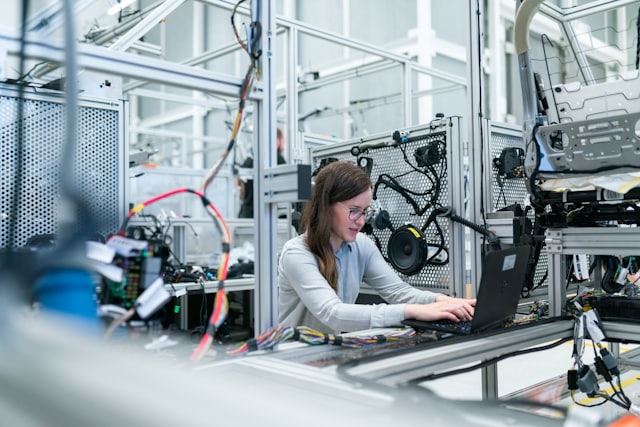
Electronics manufacturing is the industry where traceability stops being a quality tool and becomes a delivery requirement. The customer asks which lot went into which unit, and a plant that cannot answer in minutes is a plant that cannot ship.
It is also the industry where mix makes everything harder. High variety, short runs and frequent programme changes mean the line is a moving target, and the records that describe it are written across systems that were never introduced as one.
What we do in this industry is join the two directions. A unit is traceable backwards to material and settings, and forwards to test and despatch — through the same serial number, held in one place.
What we know. In electronics, a unit that cannot be traced is not a quality problem yet — it is a delivery problem waiting for the next audit or the next customer complaint. What we do not do. We do not ask you to slow the line to generate cleaner records. Anything that requires the line to wait for data capture is the wrong design.
What actually goes wrong in electronics
How we solve it
Traceability is not a report to produce later. It is a record assembled as the unit moves, with the serial number as the thread that ties both directions together.
Two things make that work in practice. First, the record is joined at the point of use rather than reconstructed — test results come off the equipment, material comes from the scan that already happens, settings come from the machine that already holds them. Second, the checks that prevent a mix error are designed with the line team, because a check the line works around is worse than no check.
What this covers in practice
Area | What we address | What it changes for you |
Traceability | Serial-level genealogy, forward and backward, joined as the unit moves | A customer question answered in minutes, not days |
Mix management | Lot, orientation and handling checks designed with the operators | The errors that mix creates stop reaching the customer |
Change control | Programme and revision changes handled as controlled changes with a record | The line never runs a superseded version without knowing |
In-process inspection | Visual checks placed where defects actually appear | Defects caught before they are hidden by assembly |
Equipment data | Test and measurement results joined to the unit | Data captured by the machine, not copied from it |
Programme data | Settings, recipe and version held against what ran them | A setting change shows which units it affected |
What we bring from this industry
The problems this industry actually presents, and what we have had to solve in them.
How we deliver
Stage | What we do | What you get |
Assess | Follow one unit from goods-in to despatch and see where its record breaks | A measured map of where traceability actually fails |
Bind | Join the existing records to the serial number, filling the gaps rather than replacing | A chain that exists from day one, using data you already collect |
Prevent | Design the mix and handling checks with the operators who run the line | Error-proofing the line will actually keep |
Hold | Change control and record discipline, then hand it over | The state held by the process rather than by the person |
What we solve
Each of these is something we take responsibility for solving in this industry.
How we work with you
Follow one unit first. The record is designed by tracing a real product, not by drawing a schema.
Use what is already captured. Machines and scans keep producing; we join rather than replace.
Design checks with operators. The people who run the line decide whether the check survives.